
What My CCIM Studies Taught Me About Housing Policy
How Financial Analysis and Lobby Day 2026 Tell the Same Story
By Jason Matthews | REALTOR® & CCIM Candidate | Queens, NY
I'm currently 92% through my CI 101 — Financial Analysis for Commercial Real Estate course through the CCIM Institute.
And somewhere between studying cap rates, cash flow analysis, and supply and demand dynamics — I had a realization.
Everything I'm learning in this course connects directly to what we were fighting for in Albany at NYSAR Lobby Day 2026.
The classroom and the Capitol were telling the same story.
Let me explain.
What CI 101 Actually Teaches You
CI 101 is the foundational course for the CCIM designation — one of the most respected credentials in commercial real estate. The course is built around one core discipline:
Financial analysis.
Not opinions. Not feelings. Numbers.
You learn to evaluate properties based on cash flow, return on investment, market dynamics, and most importantly — the relationship between supply, demand, and value.
You learn that markets are not random. They follow principles. And when those principles are ignored — or worse, legislated against — the consequences are predictable.
That's where housing policy comes in.
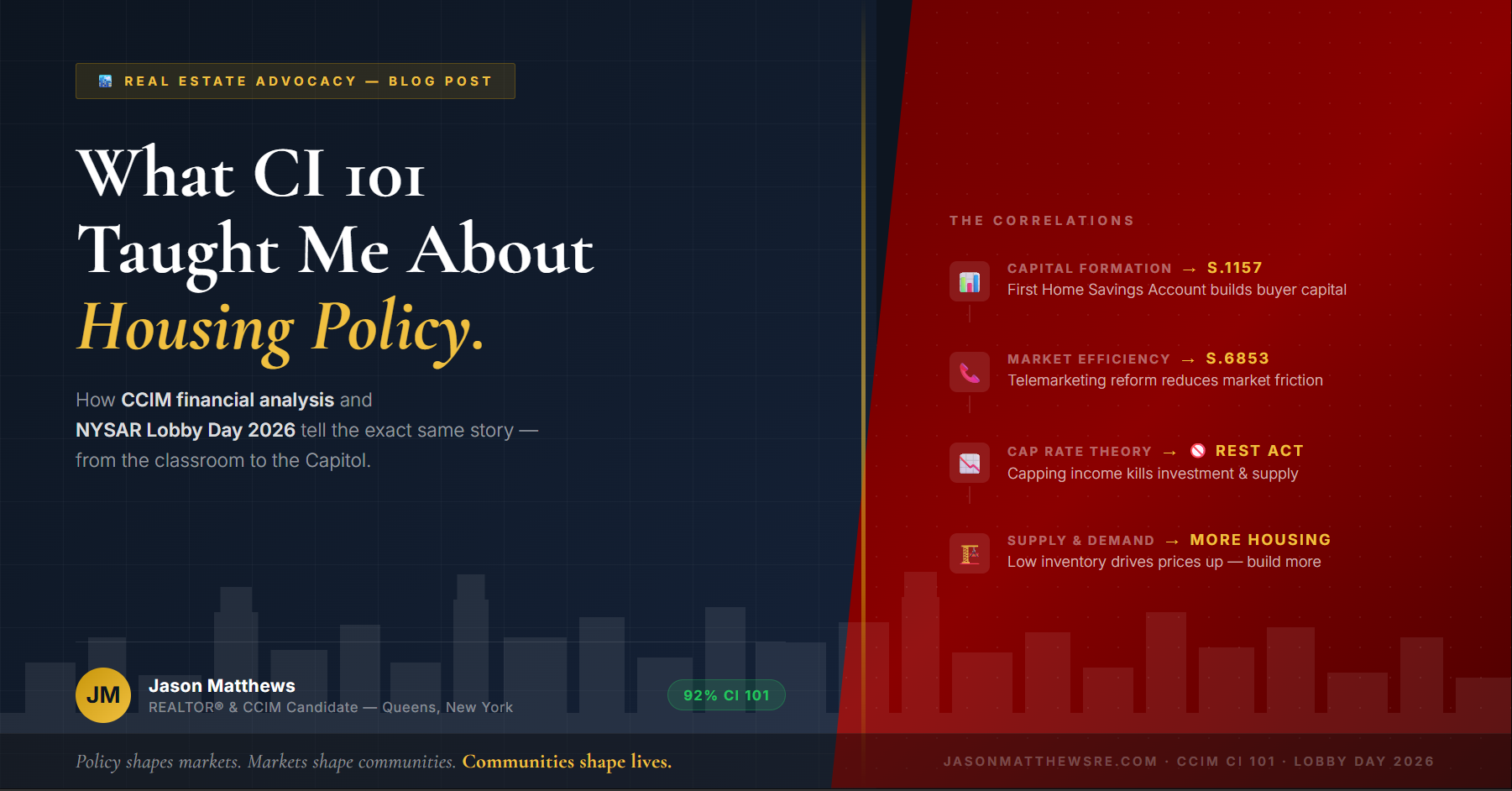
Lesson 1: Capital Formation = First Home Savings Account (S.1157)
One of the foundational concepts in CI 101 is capital formation — the idea that before any transaction can happen, capital must be accumulated and deployed.
In commercial real estate, we talk about capital stacks — the layers of equity and debt that fund a deal. Without sufficient capital at the base, the deal doesn't close. Period.
Now apply that to first-time homebuyers.
The median age of a first-time buyer in America is now 40 years old — a historic high. First-time buyers represent only 21% of the market — a historic low. New Yorkers pay among the highest closing costs in the nation.
The barrier isn't desire. It's capital.
That's exactly what S.1157 — the First Home Savings Account addresses. Modeled after New York's existing 529 college savings program, this bill creates a state tax-deductible savings account specifically for first-time buyers.
It's capital formation — applied to the residential market.
In CI 101 we learn that you cannot close a deal without capital. This bill helps buyers build it. And a state that invests in helping buyers accumulate capital gets that investment back — through transfer taxes, mortgage recording taxes, property taxes, and the broader economic activity that every home purchase generates.
The numbers make sense. The policy makes sense.
Lesson 2: Market Efficiency = Telemarketing Reform (S.6853)
CI 101 teaches you to identify market inefficiencies — gaps between buyers and sellers, information asymmetries, friction points that prevent transactions from happening at their natural equilibrium.
In commercial real estate, a good broker's job is to reduce that friction. To connect capital with opportunity. To make markets work better.
Right now in New York's residential market, there is a significant and entirely artificial inefficiency.
Realtors cannot call potential sellers.
Not because sellers don't want to be called. Not because buyers don't need inventory. But because of an ongoing state of emergency declaration — originally created during COVID to keep phone lines open during crises — that today covers executive orders on vaccine access and correctional facilities.
Nothing to do with real estate. Nothing to do with housing.
The Telemarketing Reform Bill (S.6853) — sponsored in the Senate by Senator Addabbo — removes this friction. The Assembly already voted 144-0 in favor. It costs taxpayers nothing. The Do Not Call list stays fully protected.
In CI 101 terms — this bill improves market efficiency.
I experienced this firsthand. I recently had a listing in Briarwood, Queens. Multiple qualified buyers came through — and they're still looking in that neighborhood today. But I can't pick up the phone and call a homeowner who might be ready to sell.
That's a market inefficiency. And good policy — like good brokerage — removes it.
Lesson 3: Cap Rate Theory = Why We Oppose the REST Act (S.4659-B)
This is where CI 101 gets really interesting — and where it connects most powerfully to housing policy.
In financial analysis, the capitalization rate — or cap rate — is one of the most fundamental tools for valuing an income-producing property. The formula is simple:
Cap Rate = Net Operating Income ÷ Property Value
What this means in practice is that the value of an income-producing property is directly tied to its income. Increase the income — the value goes up. Decrease the income — the value goes down.
Now apply that to the REST Act.
The REST Act would expand rent stabilization beyond New York City to municipalities across Long Island, the Hudson Valley, and Upstate New York — covering buildings as small as 4 units over 15 years old.
In plain financial terms — this bill artificially caps the income a property can generate.
Cap the income. The cap rate compresses. The property value falls. Investment dries up. Owners defer maintenance. New construction becomes financially unviable.
CI 101 doesn't teach opinions. It teaches math. And the math on rent control is consistent — decades of economic research confirm what the numbers already show.
You cannot restrict income and expect healthy investment. You cannot suppress value and expect increased supply. You cannot cap returns and expect landlords to maintain and improve their properties.
The REST Act doesn't solve the housing crisis.
It deepens it.
Lesson 4: Supply & Demand = The Housing Shortage
This one might be the most fundamental lesson in all of CI 101 — and the most directly applicable to everything we discussed in Albany.
Value follows supply and demand.
When supply is low and demand is high — prices rise. When supply increases and demand stays constant — prices stabilize or fall. This is not ideology. This is economics.
New York State's housing inventory recently hit its lowest level in nearly 30 years — with only 22,366 homes for sale statewide. The median sales price has climbed to $425,000.
Low supply. High demand. Predictable result.
The solution NYSAR is pushing for — SEQRA reform, commercial-to-residential conversions, accessory dwelling units — is fundamentally a supply-side intervention.
Build more. Convert more. Create more pathways to new units. Increase supply. Watch prices stabilize.
In CI 101 we study market analysis — understanding the forces that drive value up or down in a given submarket. Every single tool in that analysis points to the same conclusion when applied to New York's housing market:
The only sustainable path to affordability is more supply.
Not rent freezes. Not price controls. Supply.
The Bigger Picture
What strikes me most — sitting 92% through this course and reflecting on my second Lobby Day — is how rarely these two worlds talk to each other.
Real estate professionals study financial analysis. Policy advocates study legislation. But the connection between the two is direct, powerful, and largely underutilized.
When a Realtor walks into a legislator's office and speaks the language of cap rates, market efficiency, capital formation, and supply dynamics — something shifts. It's not just another advocacy group asking for a favor.
It's a financial professional explaining — with precision and evidence — why a policy will work or won't work.
That's what the CCIM curriculum gives you. And that's what Lobby Day needs more of.
Because at the end of the day — good housing policy and good financial analysis are asking the same question:
What actually creates value for people?
And the answer — whether you're in a classroom studying CI 101 or sitting across from a state senator in Albany — is always the same.
Remove the barriers. Increase the supply. Let the market connect people to opportunity.
Policy shapes markets.Markets shape communities.Communities shape lives.
And if we're not at the table?
We're on the menu. 🍽️
Jason Matthews is a REALTOR® based in Queens, New York, and a CCIM candidate currently completing CI 101 — Financial Analysis for Commercial Real Estate through the CCIM Institute. He is an active member of the New York State Association of REALTORS® and a participant in NYSAR Lobby Day 2026.
Are you a real estate professional who sees the connection between financial analysis and housing policy? Drop your thoughts below. Let's talk about it. 👇
#CCIM #CI101 #RealEstateAdvocacy #LobbyDay2026 #NYCRealEstate #QueensRealEstate #HousingPolicy #FinancialAnalysis #NYSARAdvocacy #AffordableHousing #SupplyAndDemand #CapRate #MarketEfficiency #RealtorsDoMore #NYHousing
